How Smart Startups Are Using AI Without Falling Into the Hype Trap
AI is everywhere right now.
Every startup pitch deck mentions it. Every SaaS tool suddenly has an “AI-powered” badge. And investors still love hearing the words automation, copilots, and generative workflows.
But something interesting started happening in 2026:
Users stopped being impressed by AI alone.
Now they care about one thing:
Does it actually make life easier?
That shift is changing how startups think about AI integration. The companies growing fastest today are not the ones adding AI to everything. They’re the ones using it carefully, strategically, and realistically.
Instead of chasing hype cycles, they’re building AI features people genuinely return to.
The Biggest AI Mistake Startups Keep Making
A lot of startups still approach AI backwards.
They start with:
“How do we add AI to our product?”
Instead of:
“What problem are users struggling with every day?”
That difference matters more than most founders realize.
Because when AI becomes a marketing gimmick instead of a useful tool, users notice immediately.
You’ve probably seen products like this before:
- AI chatbots that answer vaguely
- AI writing tools that produce generic content
- AI assistants that create more work instead of less
- AI dashboards filled with features nobody asked for
This is what many founders now call “AI theater.”
It looks innovative in demos.
It sounds impressive in investor meetings.
But users quietly stop using it after a week.
The startups surviving beyond the AI hype phase are doing the opposite:
they focus on very specific friction points.
The Startups Winning With AI Are Solving Smaller Problems
The most successful AI integrations today are surprisingly narrow.
Not massive “replace humans” systems.
Not futuristic sci-fi automation.
Just practical improvements.
For example:
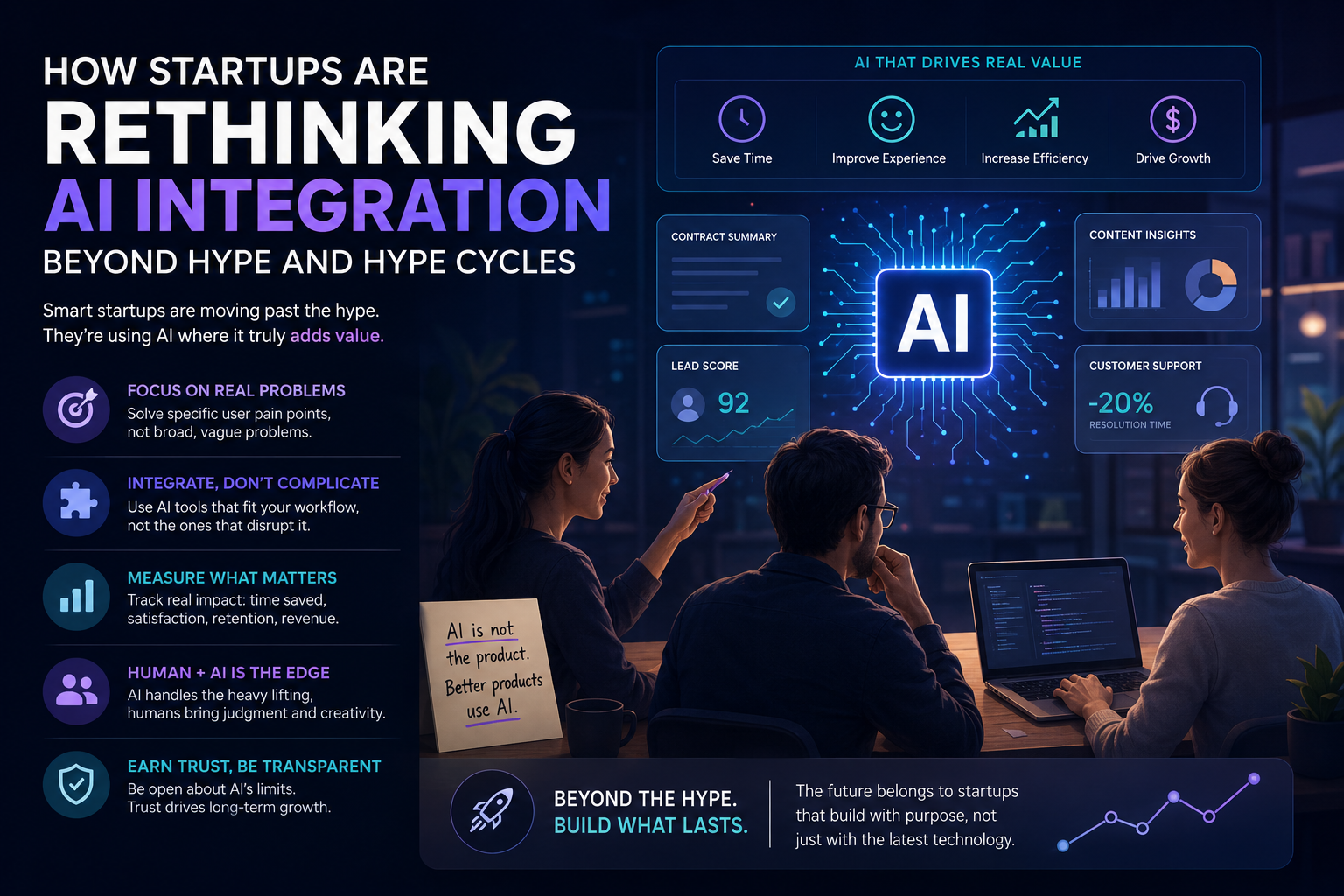
A freelancer platform uses AI to summarize long contracts instead of trying to replace legal review entirely.
A CRM startup uses AI to prioritize sales leads instead of generating fake “perfect predictions.”
A content platform uses AI to suggest underperforming articles worth updating instead of fully automating publishing.
These products work because they save time without removing human control.
That balance is becoming incredibly important.
Users no longer trust AI blindly.
They want assistance — not chaos.
Why Too Many AI Tools Are Becoming a Problem
Ironically, one of the biggest issues startups face now is having too many AI tools.
Teams are stacking:
- ChatGPT
- Claude
- Gemini
- Midjourney
- Zapier AI
- Notion AI
- AI CRMs
- AI analytics tools
- AI meeting assistants
At first, it feels productive.
Then suddenly everyone is switching between dashboards, fixing broken automations, and trying to remember which tool generated which output.
Instead of increasing productivity, the workflow becomes fragmented.
Smart startups are now simplifying aggressively.
They’re choosing fewer AI systems that integrate deeply into existing workflows rather than collecting every trendy tool on the market.
Because the truth is:
More AI does not automatically create smarter operations.
Sometimes it just creates more tabs.
AI ROI Is No Longer About Vanity Metrics
A year ago, many companies were bragging about things like:
- “Users generated 2 million AI prompts”
- “AI engagement increased 300%”
- “Users clicked our AI assistant 50,000 times”
But those numbers often meant nothing.
Now startups are tracking something much more valuable:
- Did support tickets decrease?
- Did onboarding become faster?
- Did users stay longer?
- Did conversion rates improve?
- Did teams save measurable hours?
That’s where real AI ROI lives.
One startup reduced customer support resolution time by 20% simply by using AI to identify urgent tickets faster.
Not flashy.
Not viral.
But financially meaningful.
That’s the kind of AI investors and customers are starting to trust.
Human + AI Collaboration Is Becoming the Real Competitive Edge
The companies growing sustainably with AI are not trying to remove humans from everything.
They’re building systems where humans and AI work together.
This usually looks like:
- AI handling repetitive analysis
- Humans making final decisions
- AI generating drafts
- Humans refining tone and quality
- AI detecting anomalies
- Humans reviewing edge cases
This hybrid model works because AI is still imperfect.
And users know it.
In fact, startups that openly acknowledge AI limitations often build more trust than companies pretending their systems are flawless.
Transparency is quietly becoming a competitive advantage.
User Expectations Around AI Have Changed Fast
In 2023, simply adding AI features felt exciting.
In 2026, users expect AI by default.
But expectations are much higher now.
People want AI tools that:
- feel natural
- save real time
- respect privacy
- avoid spammy automation
- don’t overwhelm workflows
- actually understand context
The novelty phase is over.
Now users judge AI features the same way they judge any product feature:
Does it work consistently?
That’s why startups focusing on user experience around AI are outperforming companies obsessed with hype.
The Future of AI Startups Looks Much More Practical
The most important shift happening right now is psychological.
Startups are slowly moving away from:
“AI will replace everything.”
Toward:
“AI can improve specific parts of existing systems.”
And honestly, that’s healthier.
Because the startups likely to survive long-term are not the loudest ones.
They’re the ones quietly building useful workflows people rely on every day.
The AI gold rush phase created noise.
The next phase is about usefulness.
And usefulness usually wins.