AI content tools are everywhere now.
Blog posts.
Instagram captions.
Marketing emails.
News summaries.
Video scripts.
SEO articles.
Even entire websites.
In 2026, creating content with AI has become normal. What used to take hours can now be done in minutes with tools like ChatGPT, Claude, and Gemini.
For creators and businesses, that sounds amazing.
Faster workflows.
Lower costs.
More output.
Better scalability.
But there’s another side to this explosion of AI-generated content that people are only starting to fully understand.
Because the real question is no longer:
“Can AI create content?”
It’s:
“What happens when most content online is created by AI?”
And honestly, the answer is getting more complicated every month.
AI Content Is Growing Faster Than Most People Realize
The internet is already flooded with AI-generated material.
Brands are using AI to publish:
- SEO articles
- ad copy
- product descriptions
- newsletters
- social media content
- customer support replies
Some companies are producing hundreds of articles per week using AI-assisted workflows.
That level of scale was impossible a few years ago.
The problem is that speed often arrives before responsibility.
And that’s where ethical concerns around AI content creation start becoming impossible to ignore.
The Biggest Ethical Problem: AI Bias
One of the most serious issues with AI-generated content is bias.
AI systems learn from existing internet data.
And the internet is not neutral.
That means AI models can absorb:
- stereotypes
- political bias
- cultural imbalance
- misinformation
- outdated perspectives
Sometimes subtly.
Sometimes aggressively.
For example, an AI writing system trained mostly on English and Western-centric content may unintentionally:
- misrepresent minority communities
- overlook cultural nuance
- reinforce harmful assumptions
- favor dominant viewpoints
The scary part?
The content can still sound confident and professional.
Which makes biased AI outputs even harder for average users to detect.
AI Hallucinations Are Still a Huge Problem
Another major ethical concern is misinformation.
AI models are incredibly good at sounding believable.
Even when they are completely wrong.
This is what people mean when they talk about AI hallucinations.
An AI system might:
- invent fake statistics
- generate non-existent quotes
- create false citations
- misrepresent scientific findings
- confidently explain incorrect information
And because the writing feels polished, many readers assume it’s accurate.
This becomes especially dangerous in areas like:
- healthcare
- finance
- politics
- law
- education
A beautifully written AI article can still spread completely false information.
Which is why human review is becoming more important, not less.
The Internet Is Slowly Becoming “AI Talking to AI”
One weird thing happening in 2026:
A lot of AI-generated content is now being trained on older AI-generated content.
That creates a strange loop.
Over time, content quality can become:
- repetitive
- generic
- overly optimized
- emotionally flat
- less original
You can already feel this happening online.
A huge amount of AI-written content now sounds strangely similar:
- same structure
- same tone
- same phrases
- same transitions
- same conclusions
Readers are starting to notice it too.
And honestly, audiences are getting tired of content that feels technically polished but emotionally empty.
Is AI Killing Human Creativity?
This is where the conversation gets complicated.
Some people believe AI is making creativity more accessible.
Others think it’s slowly replacing originality with prediction-based content generation.
The truth is probably somewhere in the middle.
AI can absolutely help creators:
- overcome writer’s block
- speed up editing
- brainstorm ideas
- improve workflow efficiency
But there’s also growing concern that creators may become too dependent on AI systems.
When every article is generated from similar prompts and trained on similar datasets, content starts losing personality.
That’s why the best creators in 2026 are not fully replacing themselves with AI.
They’re using AI as an assistant — not as a complete replacement for human thinking.
The Plagiarism Problem Nobody Fully Solved Yet
AI models don’t “copy” content the way humans do.
But they can still generate text that closely resembles existing work.
That creates serious copyright and authorship questions.
For example:
- Who owns AI-generated writing?
- Should AI-assisted articles be disclosed?
- Can AI-generated books be copyrighted?
- What happens if AI accidentally recreates existing content?
Different countries are approaching these questions differently, but globally, regulations are still catching up.
And meanwhile, AI-generated content keeps growing faster than the legal systems around it.
Why Transparency Matters More Than Ever
One thing becoming increasingly important is transparency.
Users want to know:
- Was this written by AI?
- Was a human involved?
- Was the content fact-checked?
- Is the information trustworthy?
That’s why many ethical AI workflows now include:
- human editing
- fact verification
- AI disclosure policies
- content review systems
- editorial oversight
The companies handling AI responsibly are usually the ones combining automation with real human judgment.
Because fully automated content pipelines often create long-term trust problems.
Governments and Platforms Are Starting to React
Regulators are beginning to pay attention to AI-generated content.
In many regions, discussions now focus on:
- mandatory AI disclosure
- misinformation prevention
- copyright protection
- deepfake regulation
- AI transparency standards
Platforms are also changing.
Search engines are getting better at detecting low-quality AI spam.
Users are becoming more skeptical.
Audiences increasingly value authentic expertise and real experience.
This means low-effort AI content is becoming less effective over time.
Ironically, the AI boom may actually increase the value of genuinely human content.
The Future of AI Content Creation
AI-generated content is not going away.
If anything, it’s becoming a permanent part of the internet.
But the future probably won’t belong to:
- fully human content
or - fully AI-generated content
It will belong to hybrid workflows.
The creators who succeed long-term will likely be the ones who know:
- when to use AI
- when not to use AI
- how to edit AI outputs properly
- how to preserve originality
- how to maintain audience trust
Because in the end, readers care less about whether AI helped create something.
They care whether the content feels:
- useful
- trustworthy
- accurate
- human
And that difference matters more than ever in 2026.
Final Thoughts
AI-driven content creation is changing the internet faster than most people expected.
The technology is powerful.
Sometimes incredibly useful.
Sometimes genuinely impressive.
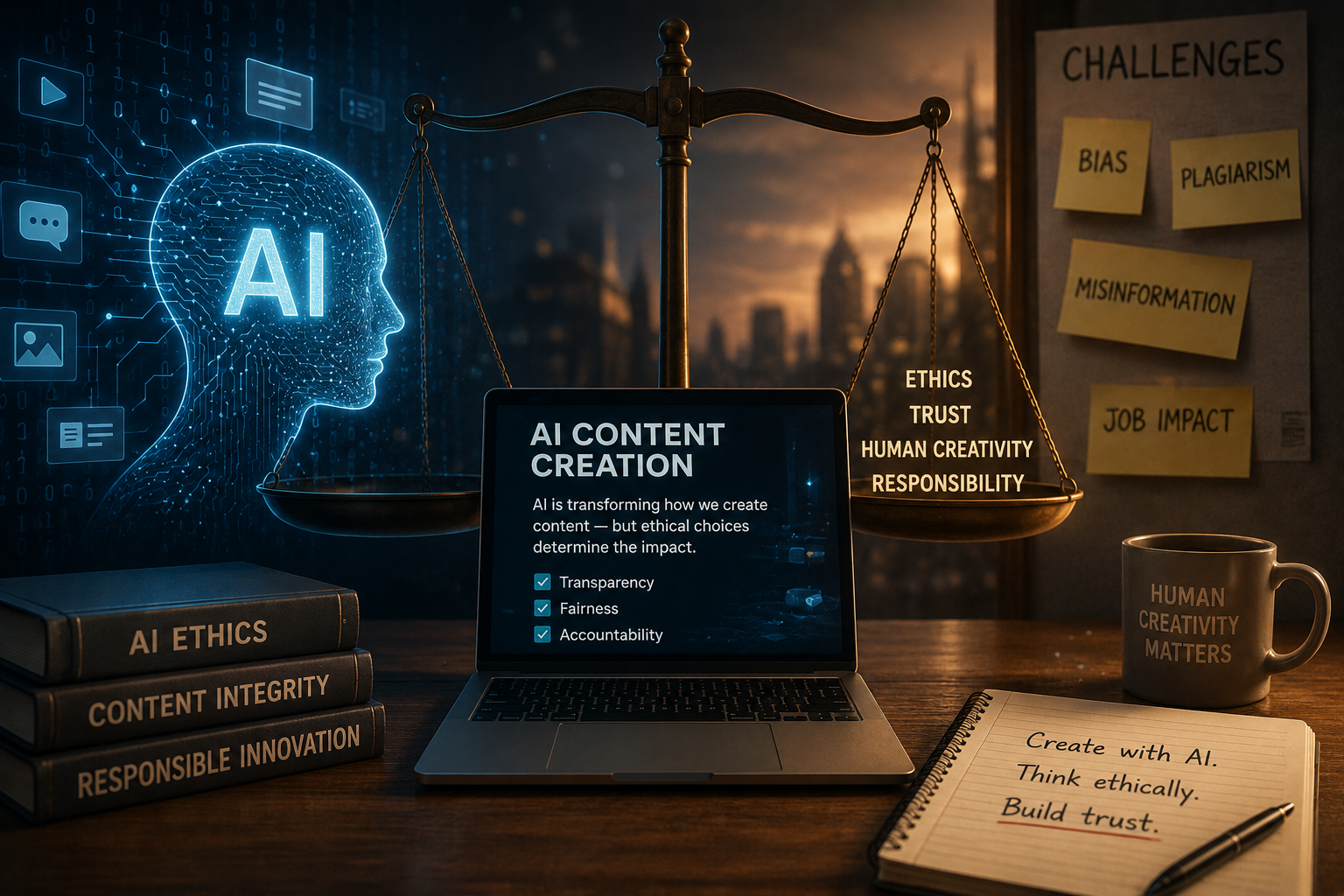
But it also introduces ethical challenges that creators, businesses, and platforms can no longer ignore.
Bias.
Misinformation.
Plagiarism.
Authenticity.
Trust.
These aren’t side conversations anymore.
They’re becoming central to the future of digital content itself.
The companies and creators who survive the next wave of AI won’t necessarily be the ones generating the most content.
They’ll be the ones people still trust.