AI tools were supposed to save creators time.
Instead, a lot of people in 2026 feel more exhausted than ever.
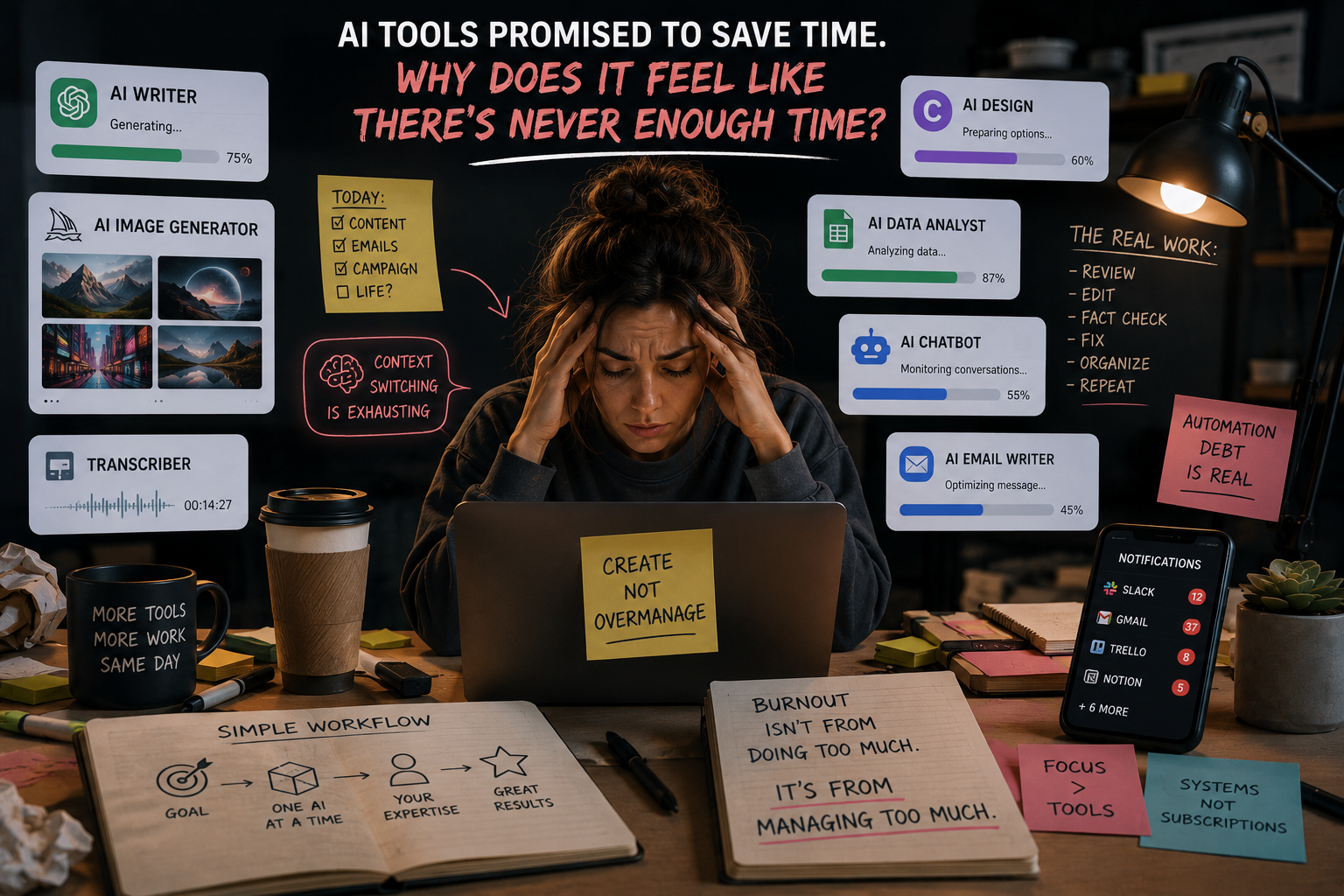
Writers are juggling AI drafting tools, marketers are bouncing between automation dashboards, developers are debugging AI-generated code, and founders are trying to manage five different “productivity” platforms at once. Ironically, the very tools designed to reduce workload are quietly creating a new kind of burnout.
This isn’t because AI is useless. It’s because most modern AI workflows were built around adding more tools, more outputs, and more automation layers — not around reducing mental load.
The result?
Creators spend less time creating and more time supervising machines.
This article explores why AI-driven workflows are becoming mentally draining, how “automation debt” is replacing productivity gains, and what creators can do to build healthier, more sustainable systems instead.
Why AI Workflows Are Making Creators More Burned Out Not More Productive
AI promised freedom.
Less repetitive work.
Less time spent on boring tasks.
More creativity.
More output.
More leverage.
But for many creators, freelancers, developers, and startup founders in 2026, reality feels very different.
Instead of simplifying work, AI often creates an endless loop of reviewing, fixing, organizing, editing, regenerating, and context switching.
People aren’t just working anymore.
They’re managing ecosystems of AI tools.
And that invisible management layer is becoming exhausting.
The Hidden Problem Nobody Talks About
The biggest issue with AI workflows is surprisingly simple:
Automation often creates new work instead of removing old work.
A designer uses AI image generators to create concepts faster…
then spends an hour filtering unusable outputs.
A writer uses AI drafting tools…
then spends half the day rewriting robotic paragraphs and fact-checking hallucinations.
A developer uses AI coding assistants…
then loses time debugging AI-generated code that technically works but breaks architecture patterns.
The workflow changes from:
“Do the work.”
to:
“Manage the AI doing the work.”
That sounds subtle, but psychologically it changes everything.
Because supervision requires a completely different kind of energy than focused creation.
AI Tools Are Quietly Creating Attention Fragmentation
One of the biggest productivity killers today isn’t laziness.
It’s fragmentation.
Modern creators constantly jump between:
- ChatGPT
- Claude
- Notion AI
- Midjourney
- Canva AI
- automation tools
- scheduling apps
- analytics dashboards
- AI transcription tools
- AI SEO platforms
Each tool has:
- different interfaces
- different prompt styles
- different workflows
- different output quality
- different limitations
Your brain never fully settles into deep focus mode.
Instead, you spend the day context switching.
And context switching is mentally expensive.
Even if every individual AI tool saves 10 minutes, the combined cognitive overhead often destroys those gains.
That’s why so many creators finish the day feeling busy but strangely unproductive.
Creators Are Becoming AI Project Managers
A weird shift is happening in creative work.
People used to create things directly.
Now many creators spend most of their time:
- reviewing AI outputs
- refining prompts
- fixing formatting
- checking accuracy
- regenerating bad results
- moving files between tools
- organizing automation systems
The creator slowly becomes less of a creator…
and more of a workflow operator.
That’s where burnout starts creeping in.
Not from hard work alone — but from fragmented, low-satisfaction work.
Because endless supervision rarely feels rewarding.
The “One More Tool” Trap
This is probably the most dangerous AI productivity illusion right now.
Something in your workflow feels slow.
So you think:
“Maybe one more AI tool will fix this.”
But usually it creates another layer.
Now you need:
- another subscription
- another dashboard
- another integration
- another learning curve
- another system to monitor
Instead of reducing complexity, AI stacks often multiply it.
And the irony is brutal:
tools designed to increase efficiency can quietly become a second job.
Why AI Fatigue Hits Creative People Especially Hard
Creative work already requires mental energy.
Writing, designing, coding, strategy, storytelling — these things depend heavily on focus and emotional clarity.
AI-heavy workflows interrupt that rhythm constantly.
When creators are repeatedly pulled into:
- editing mode
- review mode
- verification mode
- correction mode
they spend less time in actual creative flow.
And flow state is where meaningful work usually happens.
That’s why many creators report something unexpected in 2026:
They produce more content…
but feel less creatively fulfilled.
Smarter AI Workflows Usually Look Simpler
The healthiest AI users are no longer the people using the most tools.
They’re often the people using the fewest tools intentionally.
Instead of building giant automation chains, they focus on:
- one AI tool per workflow phase
- minimal context switching
- strong human oversight early
- simple repeatable systems
- reducing mental clutter
In other words:
They optimize for cognitive sustainability — not maximum automation.
That distinction matters a lot.
Because burnout is rarely caused by effort alone.
It’s caused by chaotic effort.
AI Should Support Creativity Not Replace It
The best AI workflows today treat AI like an assistant, not a replacement brain.
Good AI usage feels like:
- removing repetitive friction
- accelerating boring tasks
- generating options faster
- helping organize ideas
- speeding up technical processes
Bad AI usage feels like:
- supervising endless outputs
- fixing low-quality generations
- constantly tweaking prompts
- losing your own creative voice
- becoming dependent on automation
The difference is enormous.
And creators are starting to feel it emotionally, not just operationally.
The Future of AI Productivity Will Be About Subtraction
For years, the tech world pushed the idea that more tools meant more productivity.
But the next evolution of AI workflows will probably move in the opposite direction.
Less clutter.
Fewer dashboards.
Fewer tabs.
Fewer disconnected systems.
The creators who stay healthy long term won’t necessarily be the most automated people.
They’ll be the people who build workflows that protect focus, creativity, and mental energy.
Because productivity without clarity eventually becomes exhaustion.
And AI can absolutely accelerate exhaustion if people aren’t careful.
That doesn’t mean AI is bad.
It just means smarter workflows require something most AI marketing ignores completely:
Human limits.