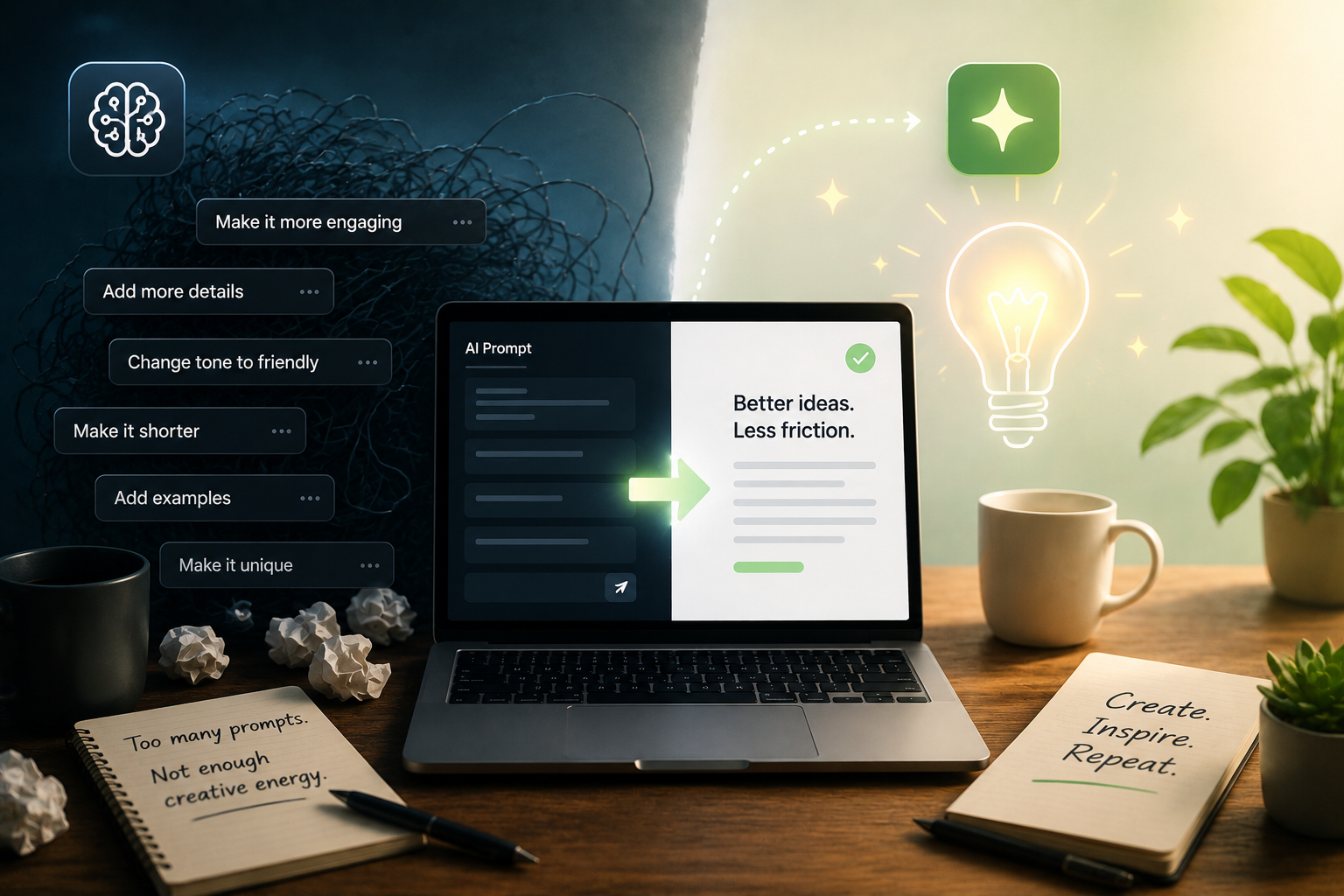
AI tools promised to make creative work easier.
Write a prompt, get an answer, refine it, and move on.
At least that was the idea.
But for many writers, marketers, freelancers, and creators, something unexpected happened. Instead of spending less time creating, they started spending more time crafting prompts, tweaking instructions, and chasing better AI outputs.
This growing problem has a name: prompt fatigue.
It's not the same as writer's block. You're not running out of ideas. You're simply becoming exhausted from constantly figuring out how to communicate with AI.
As AI tools become more powerful, many creators are discovering that the challenge is no longer generating content. It's managing the mental effort required to guide the machine.
Let's explore why prompt fatigue happens, how it affects creativity, and what you can do to avoid it.
What Is Prompt Fatigue?
Traditional writer's block happens when ideas stop flowing.
Prompt fatigue is different.
You know what you want to create, but you find yourself endlessly rewriting prompts to get the output you're looking for.
You start adding:
- more instructions
- more context
- more examples
- more constraints
Yet the results often feel only slightly better.
Instead of creating content, you're managing an AI system.
Over time, this creates a surprising amount of mental friction.
Signs You're Experiencing Prompt Fatigue
Prompt fatigue doesn't usually appear overnight.
It builds slowly.
Some common signs include:
- constantly rewriting prompts before generating anything
- spending more time prompting than creating
- feeling frustrated by repetitive AI outputs
- losing excitement about using AI tools
- overthinking every instruction you give the model
- feeling mentally drained after simple creative tasks
Many creators reach a point where writing the content themselves feels easier than explaining it to AI.
That's usually a strong signal that your workflow needs adjustment.
Why Smarter Prompts Aren't Always Better
Many users assume that better results require longer prompts.
Sometimes that's true.
But there is a tipping point.
When prompts become overly detailed, they can create new problems:
- decision fatigue
- slower workflows
- reduced experimentation
- predictable outputs
The more control you try to exert over every detail, the less room there is for creative surprises.
Ironically, simpler prompts often produce more interesting results.
The Hidden Cost of Prompt Engineering
Prompt engineering has become a skill of its own.
But like any skill, it comes with a cost.
Every minute spent:
- refining instructions
- testing variations
- correcting outputs
- troubleshooting responses
is time not spent creating.
For freelancers and content teams, this can quietly extend project timelines and increase creative burnout.
The problem isn't that AI is difficult to use.
The problem is that many users are trying to optimize every interaction.
How to Reduce Prompt Fatigue
The goal isn't to stop using AI.
It's to use it more intentionally.
1. Start with simple prompts
Don't begin with a 500-word instruction set.
Start small.
See what the AI produces naturally before adding complexity.
2. Use AI for ideas, not perfection
Treat AI as a brainstorming partner rather than a final content generator.
The pressure to get perfect outputs immediately creates unnecessary friction.
3. Separate ideation from production
Use one session for generating ideas.
Use another session for editing and refinement.
Mixing both often leads to mental overload.
4. Create prompt templates
Instead of reinventing your process every time, build reusable frameworks for recurring tasks.
This reduces cognitive load significantly.
5. Take AI breaks
Not every creative problem requires AI.
Sometimes stepping away and brainstorming manually can restore clarity faster than another round of prompting.
The Future of Prompt Fatigue
AI systems are becoming better at understanding context.
Future tools may require less detailed prompting and more natural conversations.
However, rising expectations may create new forms of cognitive load.
As AI becomes more capable, users may expect increasingly personalized and sophisticated results.
The challenge will not disappear completely.
It will simply evolve.
Final Thoughts
Prompt fatigue is becoming one of the most overlooked side effects of AI-powered creativity.
The solution isn't abandoning AI.
It's learning how to collaborate with it without letting the process consume your attention.
The most productive creators are not necessarily the ones writing the smartest prompts.
They're the ones who know when to simplify, when to experiment, and when to stop prompting altogether.
AI should reduce creative friction, not become a new source of it.