For years, startups followed the same playbook:
Build a Minimum Viable Product (MVP), launch it quickly, gather feedback, and improve based on real user behavior.
The goal was simple:
Validate an idea before investing significant time and money.
In 2026, that process looks very different.
AI tools are helping founders create prototypes faster than ever before. Product mockups, user flows, feature suggestions, customer feedback analysis, and even user testing can now be assisted by AI.
This sounds like a huge advantage.
And in many ways, it is.
But AI is also introducing new challenges that many startup teams didn't have to deal with a few years ago.
The question is no longer:
"Can AI help us build faster?"
The real question is:
"How do we use AI without losing focus on real customer needs?"
Let's take a closer look.
What Has Changed About MVP Development?
Traditional MVP development was intentionally simple.
Founders focused on building only the essential features needed to test a business idea.
The process usually looked like this:
- Build a basic product
- Launch quickly
- Talk to users
- Gather feedback
- Improve the product
Today, AI can accelerate almost every step.
Modern AI tools can:
- generate wireframes
- create UI concepts
- write user stories
- simulate user journeys
- analyze customer feedback
- identify usage patterns
Instead of spending weeks creating prototypes, founders can create and test ideas within days.
This speed gives startups a significant advantage.
However, speed doesn't automatically create better products.
The Biggest Advantage: Faster Validation
One of the most valuable aspects of AI-powered MVP development is rapid validation.
Startups can now test assumptions much earlier.
For example:
A founder can use AI-assisted design tools to create product mockups in hours instead of weeks.
Potential users can review concepts immediately.
Feedback arrives faster.
Product decisions happen sooner.
This reduces development costs and shortens time-to-market.
For early-stage startups operating with limited budgets, this can be a game changer.
AI Is Changing How Startups Analyze Feedback
Customer feedback has always been one of the most important parts of MVP development.
In the past, founders manually reviewed surveys, interviews, and support tickets.
Today, AI can process thousands of interactions in minutes.
Modern analytics platforms can identify:
- common complaints
- feature requests
- friction points
- user sentiment
- behavioral patterns
This allows teams to react faster and prioritize improvements more effectively.
But there is a catch.
Not every AI-generated insight deserves action.
The Risk of Following AI Too Closely
AI is excellent at spotting patterns.
It is not always great at understanding context.
Sometimes an AI tool may identify a behavior as important when it is actually a statistical anomaly.
Founders who blindly follow every recommendation risk building features users never truly wanted.
Successful startups still rely on human judgment.
AI should support decision-making, not replace it.
The best product teams use AI as a research assistant rather than a product manager.
How AI Can Accidentally Create Feature Creep
One surprising problem many startups face is feature creep.
AI tools constantly suggest:
- new features
- workflow improvements
- personalization options
- automation opportunities
While these ideas can be valuable, they can also become distracting.
An MVP succeeds because it stays focused.
When founders try to implement every AI-generated suggestion, products quickly become complicated.
The most successful startup teams remain disciplined.
They ask:
"Does this feature help validate our core idea?"
If the answer is no, it can wait.
Why Human Insight Still Matters
AI can process data.
Humans understand people.
This distinction remains critical.
A customer interview may reveal emotional motivations, frustrations, and goals that no analytics dashboard can fully capture.
Many successful startups combine:
- AI-driven analysis
- direct customer conversations
- founder intuition
- market expertise
The strongest product decisions usually come from combining all four.
Hidden Costs of AI-Powered MVP Development
AI tools save time, but they also introduce new challenges.
Some of the hidden costs include:
Tool Dependency
Startups may become dependent on specific AI platforms.
If pricing changes or features disappear, workflows can break.
Data Quality Issues
AI outputs are only as good as the data they receive.
Poor data leads to poor recommendations.
Reduced Founder Confidence
Some founders begin trusting AI recommendations more than their own experience.
This can weaken strategic decision-making over time.
AI should enhance confidence, not replace it.
Ethical Questions Startups Need to Consider
As AI becomes more involved in product testing and analytics, privacy concerns become increasingly important.
Startups should be transparent about:
- what data they collect
- how AI uses that data
- how long information is stored
- whether users can opt out
Trust is often more valuable than short-term optimization.
Companies that prioritize transparency are more likely to build long-term customer relationships.
What Smart Founders Are Doing in 2026
The best startup teams aren't replacing human decision-making with AI.
They're combining both.
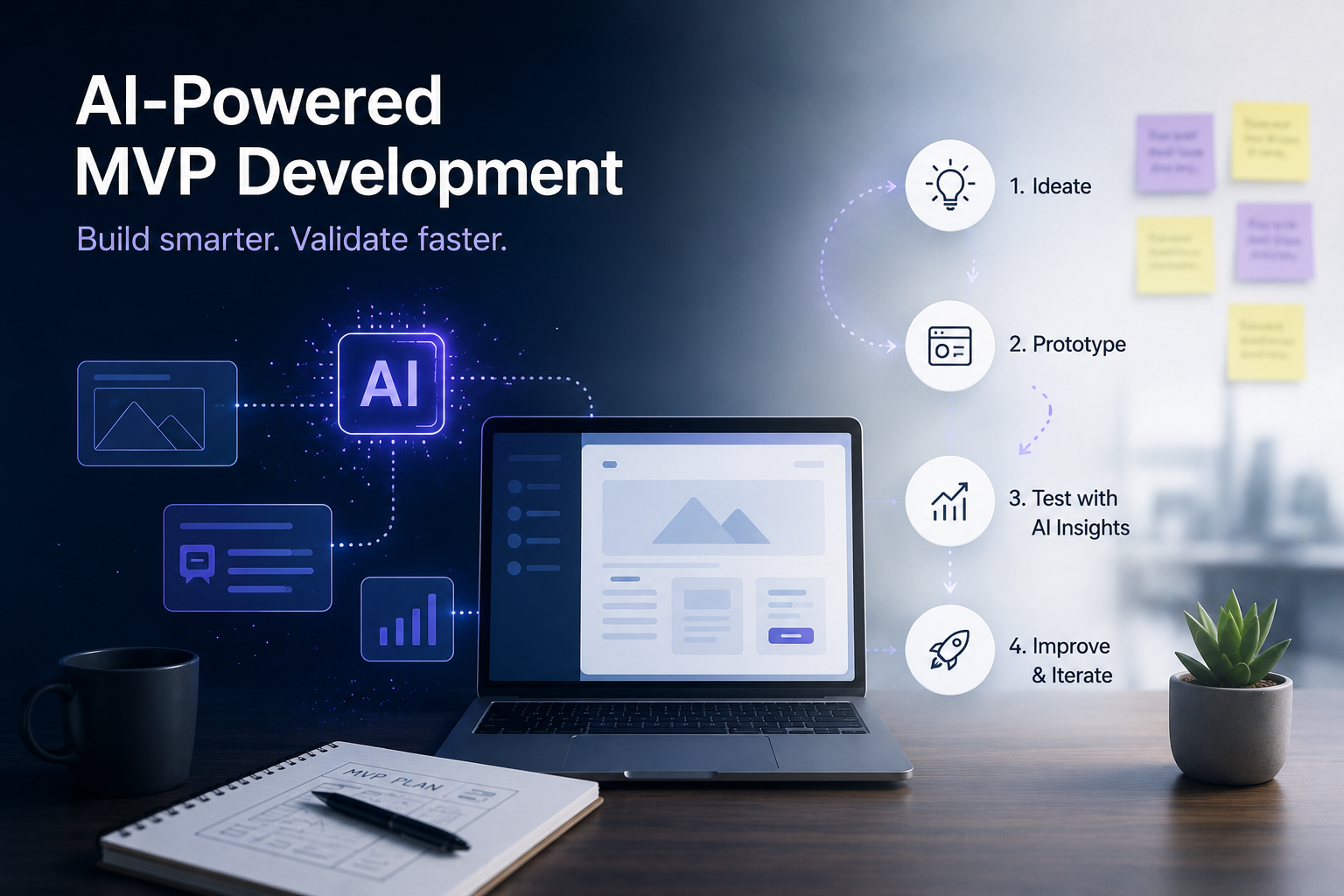
A typical modern workflow might look like this:
- Use AI to generate ideas quickly
- Build a lightweight prototype
- Gather real customer feedback
- Use AI to analyze patterns
- Review findings with the team
- Make strategic decisions manually
This hybrid approach delivers the speed of AI without sacrificing human judgment.
Final Thoughts
AI is changing startup MVP development faster than almost anyone expected.
Founders can prototype faster, analyze feedback more efficiently, and test ideas with fewer resources than ever before.
But successful startups still remember a simple truth:
Users don't care how much AI was involved.
They care whether the product solves a real problem.
The startups that win in 2026 won't be the ones using the most AI.
They'll be the ones using AI strategically while staying close to their customers.
AI can help you build faster.
Only people can tell you what is actually worth building.